Getting To and Getting Around San Cristóbal de las Casas

After a wonderful 8 days in Merida, we headed to San Cristóbal de las Casas, a city in the Chiapas region of Mexico.  We had looked into buses and flights, but after hearing terrible omens about the bus rides and finding a flight bookable on points, we opted for the plane.  We were lucky to find a great, non-stop flight from Merida to Tuxtla Gutierrez, the biggest city and capital of Chiapas.  After having no issues except for a slight delay, we arrived to Tuxtla, found a shuttle (collectivo van really, but nice) that went to the center of San Cristobal, and headed to our hostel.  San Cristobal is at 2,200+ meters elevation, so the weather here is significantly different than the 100 degree days we grew accustomed to in Merida; it's usually between 60-70 degrees in San Cristobal, and we've been wearing pants and long sleeves. For reference, Denver is at 1730 meters, and we're solidly over a mile up here.

Flying into the Chiapas highlands (Adam loves highlands)

On the shuttle ride from the airport, we could see 4 distinct rainstorms in the valleys at one point.

San Cristobal is also the rainiest part of Mexico, and this is their rainy season, so there's that, too.  After getting off the shuttle, we started our walk to the hostel, figuring we'd find food along the way.  Thankfully, the rain didn't really start getting heavy until we were right on Real de Guadalupe, a main street with tons of restaurants and shops, so we quickly ducked into the closest one we found, had some decent pizza, and waited out the heaviest rains.  We did eventually make it to our hostel, albeit a bit wet.  While we didn't get to pay as much attention to the city on our walk because of the weather and lack of familiarity, we were excited by what we saw!  There were coffee shops, restaurants, shops, people, squares, etc., and it had a very cosmopolitan feel to it.

Catedral de San Cristobal, as we waited for the walking tour to start

Some of the art at a local shop & gallery

Graffiti is common and often well done here, a hallmark of an arty city

The morning after arriving in San Cristobal, we were talking to some people at our hostel and a few of us decided to go on a free walking tour that was at 10:00am and lasted for three hours.  This was a great way to spend our first morning in town, and the tour ended up lasting for five hours!  Over the five hours, our guide Jose took us to coffee shops, and soup restaurants, and jewelry shops, and markets, and French bakeries, and spectacular viewpoints (miradors), finally ending at a Pox (pronounced 'poash') bar.  Pox is an alcohol made from corn that is native to Chiapas.  It's pretty strong, and there's a specific way that it needs to be made to be called Pox.  We were able to taste three different kinds - the regular one, a chocolate one, and a berry/hibiscus one.  As I'm not really a drinker, the regular one tasted like rubbing alcohol to me, but the other two were pretty good.  We actually headed back to the Pox bar, La Espirituosa, a few nights later and tried the other drink that they made: Cometico, made of agave (like Mezcal and Tequila).  Again, tasted like rubbing alcohol to me, but Adam really enjoyed it and got a bottle of the Blanco Cometico for himself.  I sometimes wish that I had a better palate for alcohol or even wine or beer, but I don't think it's something I'm ever going to develop or really enjoy - I'm happy that I have a pretty good palate for food.

Chocolate, Hibiscus (Jamaica) and regular Pox

San Cristobal has been a great city to walk around and explore.  It's an older colonial city, with streets made of limestone.  There are tons of restaurants of many different types, including sushi, Thai, Italian, Lebanese, and Argentinian.  While we're getting out and doing plenty of things outside of the city, we're taking our time and enjoying wandering as well.  We've met some great people here as well, many of whom are traveling or have traveled a fair bit in Mexico and Central America, and it's prompting us to think about where we're headed.  Guatemala wasn't originally on our list, but after many conversations with many travellers, we've reconsidering it.  Same goes for taking language classes - it was something we'd considered, but hadn't looked into it too deeply.  While we're picking some Spanish up, we're not picking up as much as we'd like, and I think we'd both really like to work on that soon.  Stay tuned for updates on that.

Panorama of San Cristobal near Iglesia del Cerrito

Neighborhoods are built on the hillsides around the city center

Iglesia Ex-Convento de Santo Domingo de Guzman

Near the entrance to the market, grapes and nanche (we didn't like those much)

A new friend at the wet market; we did not go down into here to Melissa's relief

Candles are sold everywhere, the colors are meaningful and they're used frequently in religious ceremonies

Adam can rarely pass up a picture of dried chiles for sale

The hostel we're staying at, La Posada de Abuelito, was singularly recommended by pretty much everything we read, and has been our most fruitful hostel, socially. The only other stay that compares is Reggae Hostel in Ocho Rios, where we made some friends early and went on several excursions together. This place has a really nice feel, especially with its heavy wool, mountain folk blankets to match the weather.

Elevation often changes here

Quality street art

Near the end of our tour, charming colonial streets with negligible sidewalks

Chip Review: Ruffles "Queso"


There's not a whole lot of detail to go into on something as simple as "Ruffles" and "Queso". It's exactly the Ruffles chips you'd expect with a slight variation on flavor than any I've seen in the US. To me, the Queso flavoring tasted a bit like Kraft Mac-N-Cheese, along with normal generic chip factory MSG type flavors.

Overall not bad, but completely uninspired. This is the Mexican chip equivalent of orange ruffles in the US; I guess Cheddar?

Ratings

Adam: 3.5/5
Melissa: 3/5

Chip Review: Airplane Snacks!

Airplane Food!  While a lot of airlines in the USA offer peanuts or pretzels as complimentary snacks on short flights, Aeromar Airlines gave us Churrositos - Botanas Lily on our quick 1.5 flight from Merida to Tuxtla Gutierrez.  They were crunchy, slightly chile-y, and pretty damn good.

Ratings:
Melissa: 4 out of 5
Adam: 3 out of 5


Chip Review: Takis

We originally bought these chips within the first couple of days of being in Mexico, but they were in our backpack when we went to the baseball game and we were not allowed to bring any food or drink into the stadium, so they were confiscated at security.  However, we saw them all over the place and bought another bag to try out.

Very, very limey flavor.  Strong, good chile flavor as well, and they kinda became addictive because if you were eating them, the flavor was excellent, but once you stopped, the lime flavor was incredibly overpowering as an aftertaste.  We had these on our roadtrip around the Yucatan, and they were reasonably easy to eat while driving as well.

Ratings:
Melissa: 3 out of 5
Adam: 4 out of 5

**I am having a hard time finding the picture.

Agua Azul, Misol Ha, and Palenque

So on Wednesday morning, Adam and I are having breakfast and I mentioned that the one thing we really needed to decide was if we wanted to try and get to Palenque after San Cristobal, while we were in San Cristobal, or skip it altogether.  Palenque is a town between Merida and San Cristobal (closer to San Cristobal) with ruins and some waterfalls nearby, and we kept hearing pretty good things about it, but it wasn't a priority the way San Cristobal was.  A German traveler, Pascal, was also having breakfast and mentioned that he had rented a car for the week was was going to drive up there on Thursday, spend the night, and drive back on Friday.  We talked about it and decided, why not?  If we did the day trip from San Cristobal, it left by 4:30am and didn't get back until 10:30pm, and you're sitting in a shuttle on very windy roads all day.  This way, we were in a car, got to stop at the waterfalls along the way, and could stop when we needed to, not just when we were told to.

A Dutch traveler, Jesse, decided to join us as well, and on Thursday morning, we headed up to Palenque.  The roads are extraordinarily windy and there are topes (speed bumps of different sizes) seemingly every 50 feet, as well as some construction going on closer to Palenque.  All this combined made the ride pretty terrible, and I was cursing myself after about an hour into the trip.  I had put on my motion sickness patch that morning, but it was not working at all.  I switched seats with Adam so I was sitting in the front; while that helped, I still felt pretty awful for most of the 6 hours spent as a passenger in the car.

Adam's Note: This drive was hellish. The roads could have been in worse condition, and no doubt we'll encounter worse in Guatemala or Nicaragua, but you need to understand that the distance is 136 miles, it took us six hours, and you basically never even reach the speed limit because by the time you get close it's time to hit the brakes for a tope or pothole or dangerous curve (curva peligrosa). Imagine six hours of constantly speeding up then immediately slowing down to 3 mph.

Pine tree as we leave San Cristobal and 2000 meter elevation

There are very few towns on the way to Palenque, only many very small poblados.
At least if you need gas you can buy it from a jug at an abarrote in one of the poblados.

We did get amazing views for most of the ride, mist covered mountains in the distance and sweeping valleys.
Unfortunately it's hard to time when the vegetation is going to open up and give you a view for photos.

The first stop is about 4 hours or so from San Cristobal, and that was Agua Azul, literally translated as Blue Water.  Because this is the rainy season and it has been raining a lot, there was no azul and it should've been called Agua Marron, or Brown Water.  The photos you see from Agua Azul are nothing like what we got to see, and I'm very thankful that we did not drive four hours just for that.

"Agua Azul"

You can imagine how this would be nice in the dryer season.

We're glad this isn't the reason we came up here.

After leaving Agua Azul, we drove up to Misol Ha - this stretch was AWFUL with construction!  Misol Ha was about 1.5 hrs closer to Palenque and is a really beautiful waterfall that you can walk behind - think Cave of the Winds if you've ever been to Niagara Falls.  The water volume was incredible because of all the recent rains, and we got SOAKED.  You also have to be incredibly careful because it's really slippery, and even though there are steps and paths that have been carved to make walking easily, it's easy to slip and fall.  There was also a cave that had a ladder and path up to, but it wasn't possible with the volume of water pouring out of it on our visit.  When we walked to the waterfall, we left the GoPro in the car but took our waterproof wallet and Adam's phone; after getting drenched and playing around, the four of us walked back to the car and got the GoPro.  I decided to hang back by the car and watch all our stuff that we put on the roof to dry while the three guys went back for some videos and pictures. While I'm guarding the rental car, a van with a group of people parked nearby and headed to the waterfalls with purses, shoes, phones, etc.  One of them spoke English, and I told her they would get soaked and not to bring anything.  She replied and said she thought some of them had been there before so they knew what to expect, but I reiterated what I said and they listened - when they returned from the waterfall, they were laughing and very grateful they had listened to me.  It's really a situation like Agua Azul - the photos you typically see are nothing like what we saw, except our experience was way cooler this time.
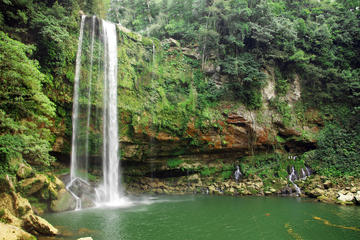
A reasonable dry-season picture of the Misol Ha falls (NOT OURS), cave to the left.

This is what we found in the wet season. Cave is not visible in the mist here

That white triangle that looks like a smaller waterfall to the right is the cave entrance. It was not accessible.

We had a drink (well, Jesse and Adam did) at the restaurant at Misol Ha so that we could dry off a bit before finishing the trip.  Due to the last minute-ness of our trip, we stayed in three different hotels and hostels.  Pascal dropped us off at our hotel, where we tried to dry our clothes a bit (there was a hair dryer in our room!).  We met up with everyone for dinner, then headed back to the hotel.

Adam's Note: we signed up for Palenque and didn't think much about the waterfalls. I was paranoid about packing for this one night trip and yet somehow forgot my swim suit. I also did not bring a change of clothes--any clothes--so I was in my soaked cotton shorts for the duration of the trip.

The sky cleared up as the day went on and we lost altitude.

Thankfully, our clothes had dried by morning.  We got to the ruins in Palenque right as they opened at 8:00 am (we're getting better at that).  While we were parking, we were approached by a group of three European travelers who wanted to hire a tour guide for the ruins and had been quoted a price of $190 USD, and were we interested in splitting it with them?  Our replies were all the same - are you nuts????  $190 US dollars?  In Mexico?  I wouldn't pay more that $150 pesos, or $8 US dollars, if I were them.  The four of us went on our own, which was definitely the right call (we did run into the other group while in the ruins and they said they ended up paying $750 pesos, which is better but still too much in my opinion).  We split up when we got into the Archaeological Zone, and Adam and I had a great morning climbing ruins and wandering through the jungle.  Palenque gets HOT, and we were sweating more than we had at any point over the last month, which is saying a lot.  But, the views were awesome.  Ruins all kind of run together after awhile (this was the fourth one we'd been to in Mexico), but these were pretty unique and big, and we were glad we went.

Adam takes over here to elaborate on Palenque

We have heard that you can see great wildlife in Palenque (about 95% of the ruins are literally in the jungle) but I think we saw fewer animals here than any of them so far. None of the howler monkeys, toucans, parrots or small mammals that other travelers had talked about. Oh well, we saw a lot on the canyon tour.

Some of the lesser known or visited ruins allow you to not only climb on them but also go inside certain structures. There are at least a few in Palenque that you can enter, two of which were very notable and were some of the biggest buildings there.

The covered part is the entrance to the Tomb of the Red Queen

Inside the temple

The first was Temple XIII, which housed the Tomb of the Red Queen. A placard outside explained that this was an unknown but likely important noblewoman, named the red queen because when they unearthed her tomb she was sprinkled with powdered cinnabar. Bold colors were hard to obtain in ancient times, and cinnabar is mercury sulfide, which is quite poisonous, so her fancy burial may have meant the death of some common men.

What they found in the Tomb of the Red Queen, source

The available inside area here was small, but it's really cool to finally get inside one of these stone buildings that we've been touring for almost a month now! You could see the room that the red queen was buried in, but not enter it. There was a short, branched hallway that was small with low ceilings, probably due to the difficulty of building with the tools the Mayans had at this time and perhaps the size of the people back then. We could stand up straight in them though.

Approaching the Palace, in shadows

Melissa checks out a hallway

The tower

Inside some of the ruined rooms

Melissa explores a balcony.

Looking back on the Temple of the Inscriptions (I think) and the Tomb of the Red Queen temple on the right.

Looking out a doorway in the Palace. Those structures on top are rather unique to Palenque, "corbeled roofs."

The second ruin that we went in was The Palace (not El Castillo!!!), which is quite notable because it was the center of the city and was a functioning palace housing the nobility, rather than a temple as at most sites. There were a few hallways or rooms that were still covered, much more spacious than the hallway leading to the red queen. Most of this building has crumbled away enough that you're walking through old rooms that are open to the outside now. One very impressive exception is the four story tower in the middle of the palace, with an internal stairway. Visitors aren't allowed to go inside this tower, but after seeing a few ruins it stands out, you just don't see levels going straight up like that!

A few of the other unique things about Palenque are its location in the jungle (a bit moreso than the others, they all kind of are in the jungle), the way the buildings take advantage of the hilly land there, the different architecture, and the excellent museum on site, literally The Sitio Museum. It's also a ruin that you can camp in overnight (as in tents and animal noises), we met one traveler who's done that, but our adventure in the Jamaican bush was enough for us for a while.

I really liked this building, looks like a cozy house.

Melissa climbs a tall one while Adam is at the cozy house.

A tree had small avocados falling from it.
We have a video of Melissa tasting it, hard and bitter but definitely avocado.

One of the pok ta pok ball courts there

We walked most of the trails in Palenque, coming out on the road into the parking lot and took that a couple hundred meters to this museum. It was really cool because many of the artifacts here were well preserved and moved to this museum, and some of the placards in the ruins explain that what you're seeing in the jungle is a reproduction and you can see the original in the museum. So being able to tie those together and get a sense of the original art and monuments that were here really adds to the experience in a way that the other ruins didn't have.

Undoubtedly the best part of the museum is the sarcophagus of one of Palenque's kings, Lord Pakal The Great, K'inich Janaab' Pakal. This was found after four years of painstaking excavation by the champion of Palenque archeology, Alberto Ruz Lhuillier. Like the pyramids in Egypt, a lot of the buildings and monuments in Palenque were created by rulers to try to one up each other for history and showcase their power in the present. This sarcophagus is one of those monuments and it was amazing.

The sarcophagus with Melissa for scale;
the angle is misleading, it's very big.

Detail of the lid, source

It's really hard to convey a sense of its size with our pictures, there were no great angles on the ground and it's surrounded with a large buffer of dead space and a thick plastic wall. It was massive though, only slightly smaller than a box that you'd build to hold a small car, like our Dodge Attitude. One source says the lid is 3.8m x 2.2m, or 12x7 feet.

The sides and lid are decorated with amazingly preserved (or restored) carvings that apparently tell the story of this ruler's birth, life, death and divinity. We're glad that the sarcophagus room explained these images because while they are clear and fascinating, archaeologists have drawn dramatically more sophisticated interpretations of the scenes than we ever could. The sides showed this king's ancestors emerging from trees in the ground (ok) and the lid showed him emerging atop an open mouthed monster, in the traditional fetal position of the gods when they are born, surrounded by deities and snakes? That's my memory of what it said and the real text was certainly weirder. I've since learned that this lid is the subject of a lot of ancient astronaut theories, as though the Mayans somehow communicated with extraterrestrials.

After a quick lunch, we headed back to San Cristobal right around noon.  The ride back was much better for me - I think my patch had kicked in and pretty effective.  We didn't stop once, and we made it back right around 6:00pm.  We were all exhausted after a whirlwind 34 hours.  Adam and I went into town, got dinner, and went to sleep.

Cenote Tour of Merida

Our time in Merida was pretty relaxing and spent mostly in the city itself, but we did decide to rent a car for a day.  We thought about keeping it for a few days, but kept it to one day and decided to prioritize what we really wanted to do with that one day.  There were a couple of haciendas we wanted to check out, some ruins that we heard were great, a museum that was supposed to be amazing, etc. - but when it came down to it, we wanted to spend some more time at some cenotes, so we decided to do that first and then see what time it was (spoiler: it was like 3:30pm by the time we left the cenotes, and the sky had gotten DARK.  Pouring rain started on the drive back to Merida).  We had looked into a bunch of cenotes, and decided to check out the Cenotes of Cuzama.

We got to the rental car agency, put our lucky $200 on the dash, and headed out.  While Google hasn't always been the most accurate with their locations for Mexico, they were thankfully spot on for this one.  The drive took us through some small towns and wasn't too bad (maybe an hour and fifteen minutes?).  The only real problem with the drive was that when you get into Cuzama, all of these kids on bikes want you to follow them so that they can ask for a tip.  Which is fine if you're doing that - but we are shaking them away, telling them no, and they don't stop.  We eventually got to more of a dirt road which they clearly didn't want to go down, and we just kept going.  We got to the correct spot where we could park, walk 10 feet, and get into a cart pulled by a horse down some old tracks - for up to 4 people, it's $350 pesos (a little less than $20).  It's just one track, so if people were coming in the other direction, one of the carts had to stop and the guide had to pull it onto the dirt/grass so the other could pass.


Our ride for the afternoon.

The first cenote, Cenote Dzapakal was amazing.  You have to walk pretty far down some ladders to get into the cenote, and it is DARK.  They have one electric light rigged up so you can see a little, but it's incredibly dark and incredibly cool.  I have a love/hate relationship with heights - they don't bother me when I'm up that high, but having to descend is the problem when it's super steep ladders (this is why I could not do the viewpoint at the biosphere reserve).  So in the case for these cenotes, going down the ladder was first which made it MUCH better - because if I could make it down, the hard part was over.  Climbing up doesn't stress me out.  Anyways, this first cenote: Adam went down the ladders first, and when you get to the water, it is SO clear and SO dark that you can't really tell where it starts.  The water is cool, as it's dark and doesn't get any sunlight to warm it up, but it was pretty refreshing.  It was a pretty small cenote, no more than 15-20 feet across, but we were the only ones in there at that time so it was perfect.  Adam was more freaked out than me once in the cenote because of the darkness; I was fine once I was at the water.

The other tricky thing about this one is that there is no "beach" area, you have to jump straight from a platform 3 feet out of the water into a dark pool, then climb out by rope.  There's no real gentle introduction to this one, you have to go for it!

About halfway down to Dzapakal. 
This doesn't capture the darkness or difficulty seeing where the water starts you have in person.

Further up, a sense of the stairs and how far down this thing is.


Video from the first cenote.  You can get a sense for how small and dark it was!

After spending 15 minutes or so in that cenote, our guide walked us to the second one, Cenote Santa Cruz.  This was easily the least exciting and cool of the three cenotes.  There were two other people in there, and we didn't spend more than 15 minutes in this one either.  It was much more shallow than the other two - you could stand in most of it, as opposed to the other two.  It was significantly bigger than Cenote Dzapakal, but nothing particularly stood out. It was also very cloudy whereas the other two were crystal clear, so although you can see a few fish near the surface there's much less exploring underwater to do.

The paths between the first two cenotes.  Clearly the least favorite cenote was the second one as I'm going through a ton of pictures and videos and can find none of that one.

For the third cenote, Cenote Chelentun, we got back on the horse drawn cart and rode for quite awhile.  This one was Adam's favorite.  It was huge, super clear, blue water, and very refreshing.  There was a large group of maybe 30 people there when we got there, but they left within 10 minutes - at one point, Adam went to use the restroom and I was completely alone for about 2 minutes, in this perfectly clear, still water.  A few small groups came while we were in there, including some very local kids who had no fear, climbing 10 meters up the wall and jumping from a tiny ledge!  We stayed in this cenote for a couple of hours, exploring all the parts of it.  Amazing.


Me jumping into the perfect water.

Cenote Chelentun

From a different angle


Some video for perspective.

We got back to our car around 3:30pm and decided to just head back to Merida instead of checking out some haciendas.  Right call, because it started pouring during our drive back.  We made it back to our hostel without any issues, both thankful that we had spent the day in the cenotes.

A Week in Merida

After dropping our reliable Dodge Attitude back off in Cancun, we hopped on a bus for a 3.5 hour ride to Merida.  Bus rides in Mexico are NICE - this was a really nice bus, lots of leg room, good air con - and made for an easy trip to Merida.  When we arrived in Merida, it was POURING - definitely the most rain we had seen since Jamaica.  Since we'd only had a light lunch in Cancun, we found a place right across from the bus station and grabbed a quick dinner.  It was NOT good.  Luckily, we found a cab to take us to our Airbnb.  If it wasn't pouring, we could've walked it, but a cab was about $2 and totally worth the money.

Our Airbnb, Villa Merida, was amazing.  It's this old mansion that was renovated and now has about 7 rooms that you can rent.  Since it was already 8:00pm by the time we checked in, we just hung out in our gorgeous room with incredibly fast wi-fi.  Adam had been trying to upload videos and pictures from Bacalar and Chichen Itza when we were in Valladolid and it was taking 12 hours to upload half a video; in Merida, he uploaded about 50 videos in 5 minutes.  The super fast wi-fi was really nice; we were able to video chat with our families (and my parents happened to be in Connecticut that week, so I got to see my favorite little faces, too).

We met our host, Naima, the next morning, and she was super helpful and gave us lots of suggestions for things to see and places to eat. I was really needing some non-Mexican food, and Merida had lots of options.  The first place we went to was a Mediterranean restaurant called Pita, which was GREAT.  Adam's falafel was just as good as any you could find in New York (and so good that I made us go back on our last day so I could get one!), and I was finally able to have the salad and greens I was craving.

Pasta from Oliva Kitchen: penne pomodoro (front) and taggliatelle ragu back right. 

Shaksouka and Falafel from Pita, excellent, plus vegetables!

A lot of our time in Merida was spent wandering around, relaxing, and eating.  Our Airbnb was about a 20 minute walk from Plaza Grande, which is the main square in Merida (Merida has TONS of squares.  It's the largest city in the Yucatan).  While 20 minutes doesn't sound so bad, it was about 100 degrees there everyday, with high humidity.  And unlike Cancun, the buses were not easy to figure out.  We were able to figure them out enough to take us INTO Centro, but always ended up just taking a 30 peso cab back.

Merida on one of our first nights

After the first day in Merida, we decided we liked the city and our Airbnb enough to extend for a few more days.  Unfortunately, our room was booked, so we had to switch rooms after the first three days.  While both rooms were wonderful, the first room was nicer.

One of the things we wanted to do in Merida was cook!  The kitchen was gorgeous - it looked like something out of Top Chef with rows of silver counter tops.  We decided we were going to make skirt steak fajitas with rajas, and stopped by the market to pick up what we needed (rajas is sliced and sauteed poblano chiles and onions).  Now, the thing with Mexico is that you can find any kind of chile pepper anywhere.  ANYWHERE - except for the market near our Airbnb, which had no poblanos.  And, in my preoccupation with looking for poblanos, I completely forgot the onions and didn't realize this until we started cooking.  Also of note with this market - it had way more rum than tequila, which isn't really something you expect for Mexico...

The advantage to traveling with Adam, amongst other things, is that he's pretty inventive when he needs to be.  The kitchen had this great plancha to cook on (flat top grill), which was perfect for the steak and peppers (I settled on plain green peppers), except that it wouldn't light because the long lighter was out of fuel and the matchboxes were empty.  Well my incredibly resourceful love found a leftover box of spaghetti, lit one with a small lighter that was in the kitchen, and was able to light the plancha from underneath to get it working.  Score!  Dinner ended up being really good, and our host was impressed that we got the plancha working since apparently no one had been able to get it working in months.

The enormous kitchen at Airbnb. So many prep tables...

Our successful if not exactly as intended skirt steak tacos (unassembled)
with margaritas we made from limes, oranges and tequila.

Over the next few days, we did a walking tour of the city (Adam wrote about that already), walked down Paseo de Montejo (the Merida version of the Champs de Elysee, which, no joke, had a Starbucks on it that had valet parking.  VALET PARKING FOR A STARBUCKS!), checked out the Museo de Anthropologia, had really good Italian food (I wrote about that in an earlier post as well), and spent our time learning about Merida.  However, the one thing we had a really hard time finding were marquesitas.  Marquesitas are a dessert item that you can typically find being sold on the streets, much like churros are sold.  Marquesitas are kind of like a really thin waffle with fillings added, folded, and a garnish on the top.  They are originally from Merida, so we were expecting to find them everywhere!  We were only able to find them on the Sunday we were there, when Plaza Grande becomes a giant market with tons of food, dancing, craft stalls, etc.  So while we were only able to find them that last day, they were worth the wait.  The traditional one with Queso de Bola (Edam cheese) and Cajete (a goat's milk caramel that is ubiquitous here) was delicious, and Adam was very happy he finally got one.  (The other things that were unique to Merida but that Adam did NOT get to try were Burger King's Whopper with Doritos and McDonald's Queso Fries).

We did not take advantage of Starbucks valet.
We did take advantage of its air conditioning

On the lookout for another Burger King after missing this...

Walking in Merida can be tricky - it's a very old city, and a lot of the streets and sidewalks are made of limestone (funny story: Adam got really interested in learning about the limestone, and all I kept thinking was of the scene from Parks and Rec when Ron gets annoyed with Tom & Lucy for being ridiculous and missing out on a fascinating conversation about Michigan limestone.  Yes, I miss Parks and Rec).  Well when it rains, smooth limestone becomes very, very slippery so you have to be extremely careful.  From Adam's notes: most of the Yucatan is made of limestone as soil is only a few meters deep at best.  It dissolves over time to form caves and cenotes, and is made of dead sea animals, a different kind of marble.  The Spanish ripped up five Mayan pyramids to build churches and markets, and all the streets in centro are covered in limestone and buildings use it extensively as well.  The other danger in walking around Merida is that the buses drive very, very fast and close to the curb, so you just need to be aware so you don't get hit while you're trying not to slip off the narrow sidewalks.

However, the real highlight of our time in Merida was the Pok ta Pok game that was held in the main square on Friday night.  I believe Adam wrote about Pok ta Pok when he wrote about Chichen Itza - it's a ball game that was played by the Mayans where you hit the ball with your hip to try and get it through these holes that are about 3 meters or so off the ground.  Yes, it's as bizarre as it sounds.  On Friday nights, Merida has a Pok to Pok game, where the athletes don full costumes and make-up and play this game.  After the first round, they light the ball on fire and throw it around, kind of like volleyball, trying to throw it through the hoops.  It was incredibly fascinating to watch.


After 6 days at the Airbnb, we spent our last two nights at a hostel right on Plaza Grande.  It was really nice to be right in the middle of everything, and it was a nice change of pace before we headed to San Cristobal on Monday afternoon.  All in all, Merida was wonderful, and I'm so glad we were able to spend 8 days there.

An elaborate roundabout on Paseo de Montejo

Walking along Paseo de Montejo

A Museo on Paseo de Montejo, these often used to be wealthy family estates

A bird head at the anthropology museum

Average street corner in Merida